Transform Your Small Business with AI in 2026
AI, Automation, Small Business, Agencies
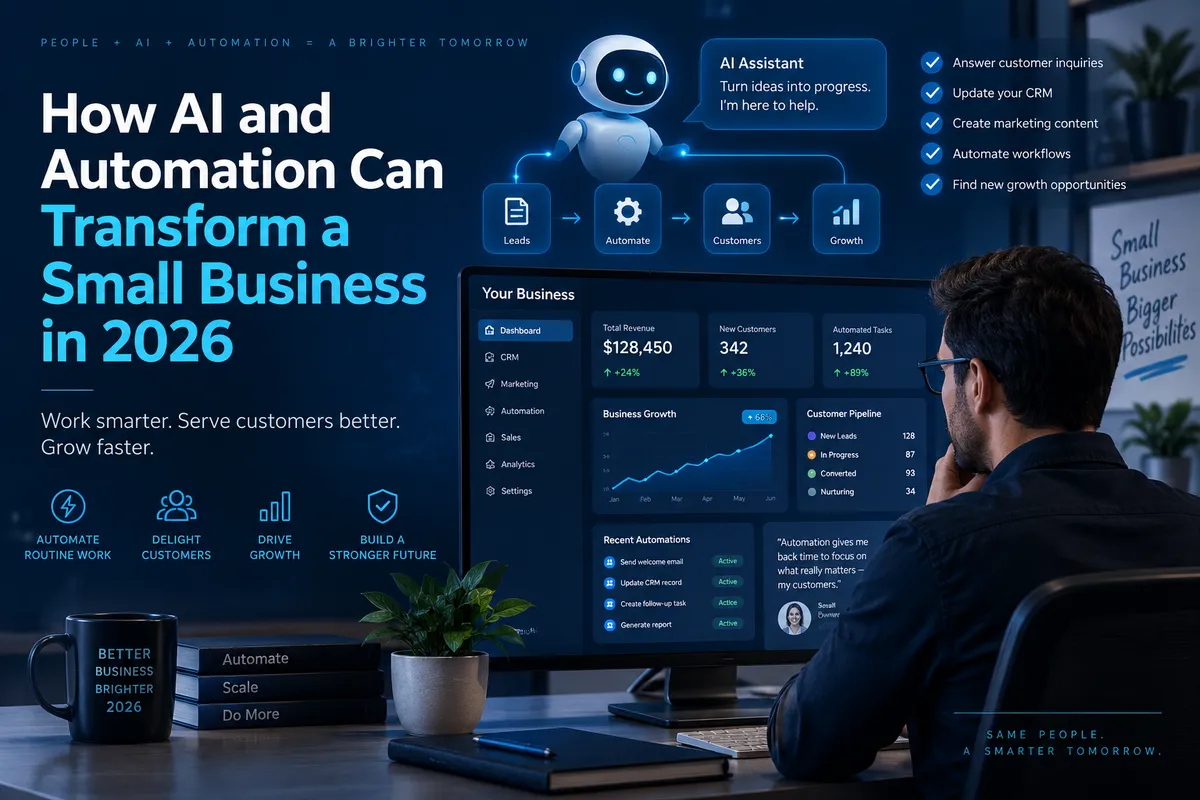
How AI and Automation Can Transform a Small Business in 2026
By 2026, AI and automation will no longer be “nice-to-have” add‑ons for small businesses and agencies. They will be the quiet engine behind how you win clients, deliver work, and protect your margins in an increasingly competitive market.
Why 2026 Is a Turning Point for Small Businesses and Agencies
Over the next few years, the cost of implementing AI will continue to fall while tools become dramatically easier to use. Forbes and Inc. both predict that by 2026, AI will be integral to small business strategy, not just a back-office experiment. Agencies, consultancies, and service-based businesses will feel this shift first, because their clients will expect faster delivery, deeper insights, and more personalized experiences at the same or lower price point.
For owners and agency leaders, the opportunity is clear: use AI and automation to remove low‑value tasks, unlock data you already have, and build a leaner, more resilient operation. Those who do will gain a real edge; those who do not may find themselves priced out or outpaced by competitors who deliver more with less.
1. Personalized Client and Customer Experiences at Scale
One of the most powerful shifts coming by 2026 is the ability for even the smallest agency or local business to deliver truly personalized experiences. AI tools can already analyze behavior, purchase history, and engagement patterns; in the next few years, these capabilities will become more accessible and more tightly integrated with everyday platforms.
A marketing agency can automatically tailor email content, offers, and timing to each subscriber using AI‑powered platforms like Mailchimp or ActiveCampaign, improving open and conversion rates without manual segmentation work.
A small e‑commerce brand can use AI recommendation engines to show each visitor products and bundles most likely to convert, similar to what retail giants already do, but at a fraction of the historical cost.
According to recent forecasts, AI‑driven personalization will become standard practice by 2026, not a premium feature. For agencies, this means your clients will expect you to bring these capabilities to the table as part of your core service offering, not as an optional add‑on.
2. AI‑Powered Marketing That Works While You Sleep
AI is already reshaping how small businesses market themselves, but by 2026, “set it and forget it” will take on a whole new meaning. Intelligent marketing platforms will be able to:
Optimize ad spend automatically across channels like Google, Meta, and LinkedIn based on real‑time performance, not just static rules you set once a quarter.
Generate and test creative—headlines, images, and calls‑to‑action—using AI, so agencies can run more experiments in less time without burning out creative teams.
Automate social media engagement with smart scheduling, content suggestions, and AI‑assisted replies that still sound like your brand.
For agencies, this is a double win: you can offer higher‑performing campaigns while reducing the manual work that currently eats into retainers. Instead of spending hours scheduling posts or exporting reports, your team can focus on strategy, creative direction, and high‑value client conversations.

AI‑driven campaign optimization lets small teams manage more accounts without sacrificing results.
3. Automating Routine Operations: From Admin to Delivery
Routine tasks are the silent profit killers in most small businesses. Scheduling, invoicing, chasing approvals, updating spreadsheets—none of them directly generate revenue, yet they consume a surprising share of your team’s week. AI and automation tools are set to remove much of this friction by 2026.
Modern CRMs like HubSpot or Zoho can already automate follow‑ups, deal stages, and reminders. Accounting platforms such as QuickBooks and Xero streamline invoicing and reconciliation. By 2026, these systems will be more deeply connected, using AI to:
Flag invoices at risk of late payment based on client behavior and suggest proactive outreach.
Auto‑create project tasks in tools like Asana or Trello when a proposal is signed, complete with timelines, owners, and dependencies.
Adjust inventory or resourcing plans based on predicted demand, using patterns from your historical data and market signals.
💡 Pro Tip for Agencies: Map your client journey from first contact to final invoice and mark every manual hand‑off. These are prime candidates for automation in 2026.
4. Smarter Customer Service with Chatbots and Virtual Assistants
AI chatbots and virtual assistants are moving quickly from clunky and frustrating to genuinely helpful. For small businesses and agencies, this opens the door to 24/7 support without hiring a round‑the‑clock team. By 2026, expect AI assistants that can:
Answer common questions using your knowledge base, proposals, and past email threads as training material, keeping responses on‑brand and accurate.
Qualify leads on your website by asking a few targeted questions, then routing hot prospects directly to your sales team’s calendars.
Provide proactive updates on orders, projects, or campaigns, reducing “just checking in” emails that clog inboxes on both sides.
For agencies, white‑label chatbot solutions can become a new revenue stream: you can design, train, and manage AI assistants for your clients, deepening retention and expanding your service mix beyond traditional creative or media work.
5. Predictive Analytics: From Guesswork to Confident Decisions
Many small businesses still rely on gut feel when making big decisions: when to hire, what to stock, which services to promote. AI‑driven predictive analytics changes that by turning your historical data into forward‑looking insight. Reports suggest that by 2026, predictive tools will be embedded into mainstream platforms, not limited to enterprise‑grade software.
Imagine being able to:
Forecast revenue for the next quarter based on pipeline quality, seasonality, and marketing performance—then adjust spend accordingly.
Identify which clients are most likely to churn and proactively design retention campaigns or check‑in calls.
See which services or packages are likely to grow fastest in demand, informing hiring and training priorities.
For agencies, offering predictive dashboards to clients can transform your positioning from “service provider” to strategic partner. You are no longer just executing campaigns; you are helping clients read the future of their own markets.
6. Stronger Cybersecurity Without a Full IT Department
As small businesses adopt more digital tools, they also become more attractive targets for cybercriminals. The good news is that AI is making enterprise‑grade protection more accessible. By 2026, expect security tools that quietly monitor your systems, detect suspicious behavior, and respond in real time—without requiring you to be a security expert.
For agencies handling client data, this is especially critical. AI‑enhanced security can help you:
Spot unusual login patterns or data access before they turn into a breach.
Automate backups and recovery plans, reducing downtime if something goes wrong.
Demonstrate strong data protection practices to clients, which can be a differentiator in competitive pitches.
7. AI‑Driven Training and Better Use of Human Talent
AI is not only changing how work gets done; it is also changing how people learn to do that work. By 2026, AI‑driven training platforms will be able to tailor learning paths to each employee’s strengths, gaps, and pace, making upskilling more efficient for small teams with limited training budgets.
For agencies, this means you can:
Onboard new hires faster with role‑specific learning journeys that adapt as they progress.
Keep your team current on rapidly changing platforms, from ad networks to analytics tools, without sending them away for long, generic courses.
📌 Key Takeaway: AI should not replace your people; it should remove repetitive work so they can focus on creativity, strategy, and relationships—the areas where humans still win.
8. Practical First Steps for Small Businesses and Agencies Today
The biggest mistake leaders make is trying to “do AI” in one giant leap. Instead, treat 2026 as a clear horizon and work backward. Here is a simple roadmap you can start on now:
Audit your workflows. List the top 10 recurring tasks that take time but do not require deep expertise—reporting, scheduling, basic client updates. These are prime automation candidates.
Leverage AI inside tools you already use. Many platforms—HubSpot, Mailchimp, Shopify, Zendesk, and others—are rolling out AI features at no or low additional cost. Turn them on, test them, and measure impact.
Pick one client‑facing experiment. For agencies, this might be an AI‑assisted report, a chatbot pilot, or predictive dashboards for a key account. Use the results as a case study to win more buy‑in internally and externally.
Set guardrails. Define where AI is allowed to act autonomously and where human review is mandatory—especially for content, pricing, and sensitive client communication.
Looking Ahead: Building a Future‑Ready Business for 2026 and Beyond
By 2026, AI and automation will not magically fix broken business models or replace the need for clear positioning, strong leadership, and excellent service. What they will do is amplify whatever is already there. Agencies and small businesses that are organized, curious, and client‑obsessed will find that intelligent tools help them move faster, see further, and deliver more value than ever before.
The question is no longer whether AI will transform small business—it is whether your business will be ready to take advantage of that transformation. Start small, learn quickly, and build AI and automation into the fabric of your operations. When 2026 arrives, you will not be scrambling to catch up; you will be leading the way.